
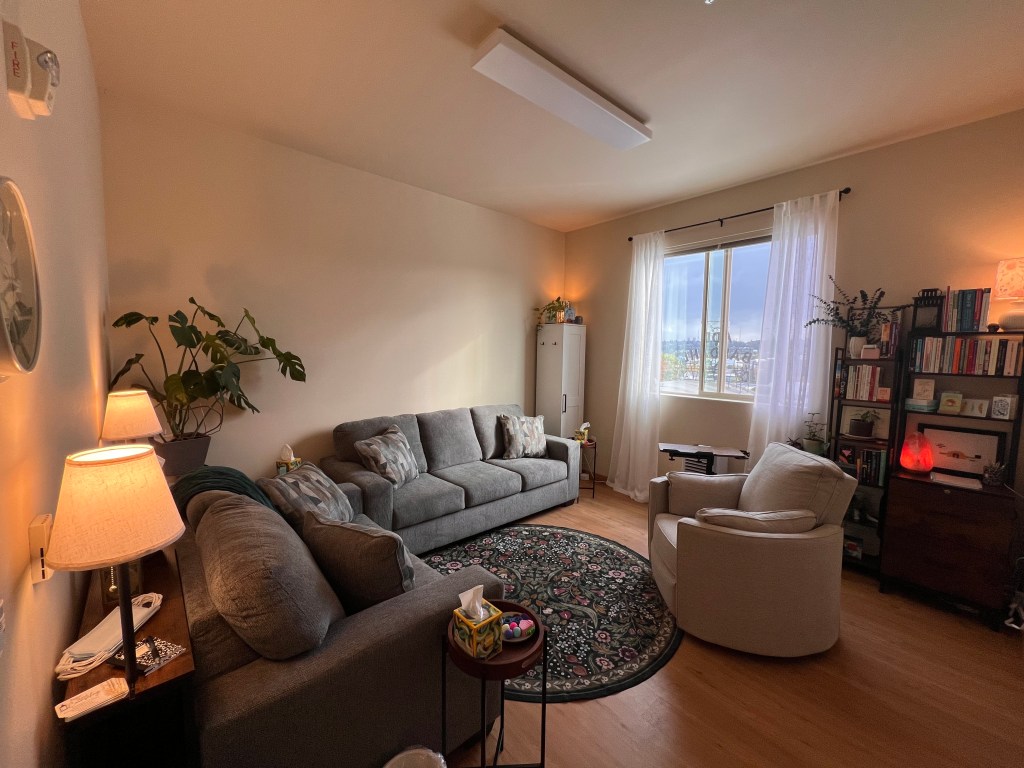
I am an integrative Relational-Cultural (RCT) therapist; in other words, I believe that human beings grow through relationships with others, and that I draw from other therapy modalities based on your needs and goals.
I’m a therapist who will:
- Be curious about, and try to deeply understand, your lived experience and what makes you, you.
- See you as the expert on yourself.
- Collaborate with you on insights, tools, and new ways of being. I see therapy as something we do together.
- Challenge you and hold you accountable.
- Own when I make mistakes, and do my best to repair rupture with you.
- Continuously educate myself, not just on emerging theories and techniques, but also on the application of social justice, decolonization, and anti-oppressive practices within therapy and mental health counseling.
In my practice, I draw from:
- Emotionally Focused Individual (EFIT), Couple (EFCT), or Family (EFFT) Therapy (I am trained and recognized by ICEEFT as an EFIT and EFCT Therapist)
- Dialectical Behavior Therapy (DBT) or Radically-Open Dialectical Behavior Therapy (RO-DBT)
- Acceptance and Commitment Therapy (ACT)
- Parts work (similar to internal family systems, or IFS)
- Somatic-based practices
- Existential Therapy
- Strengths-Based Therapy
- Motivational Interviewing
I also practice embodied movement and meditation, use tarot cards for growth and development, and follow lunar and seasonal cycles to guide and connect to something larger than the self. If you are interested, I would be more than happy to discuss bodywork and spirituality in addition to “typical” counseling styles.
At my core, I believe that humans grow through, and toward, connection and relationships with other people; this is the fundamental belief of Relational-Cultural Therapy (RCT). As your mental health counselor practicing from this orientation, that means we might discuss the ways the two of us work together in our therapeutic relationship; where you might be facing challenges in personal or professional relationships; and how you relate to the broader systems of society (e.g. patriarchy and white supremacy, capitalism, individualism and community), and how all of these relationships impact your well-being and goals.

Is your practice trauma-informed?
My practice as a whole is trauma-informed: RCT and emotionally-focused therapy (EFT) are, by nature, trauma-informed. I practice trauma-informed versions of ACT, parts work and DBT, including RO-DBT. Depending on your goals and needs, we may discuss things that happened to you, how their echoes have reverberated through your life, and methods by which you can carry your trauma a little more easily. However, you are in charge of how quickly, or if, we even look at those things. It is deeply important to me that you feel safe in our therapeutic relationship so we don’t excavate too much, too soon.
As your therapist, I see myself as your hermit guide: in the archetype, the hermit holds a lantern and stands alone on top of a mountain, representing deep, solitary introspection and emotional and spiritual growth. As your hermit guide, I will walk the path of life alongside you, holding the lantern: this will make it easier to see the path in front of us, but it is also my job to shine the lantern in areas of darkness you may be avoiding to help you move forward with less fear and more clarity. However, we walk the path together, so you will not be alone on this journey.
